Core Standard 3: Cognitive
Analyze, synthesize, use inductive and deductive reasoning, solve problems effectively and creatively.
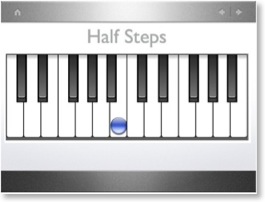
For this standard I chose my individualized instruction project from EDTEC 671: “Music Theory Course.” Links to the relevant files are in the sidebar.
Context
This artifact was created to satisfy the individualized instruction assignment for EDTEC 671 with Dr. Bob Hoffman. This course covers many aspects of learning environment design, including reusable learning objects, usability testing, learning management systems and interface design. While I was initially drawn to the course for the informal learning component, I became intrigued by the modularity of reusable learning objects. I wanted to create a musical theory lesson that would incorporate interface and programming elements that could be reused in other modules of the course.
Outcome
This artifact represents the cognitive standard in more than one way. While the actual assignment did include a cognitive task analysis and a content analysis (see sidebar for links to those items), the actual programming of this module also posed many cognitive challenges that will be described further in the next section. The content of even this elementary music theory lesson included facts (key signatures), concepts (the patterns of the major and minor scales), principles (recognizing the scales), and procedures (playing the scale on the keyboard). While I thought I came up with an appropriate design, developing a learning environment with such varied content with a rich interactive interface stretched the limits of my abilities as a programmer.
Challenges and Opportunities
My original idea was to have a fully interactive onscreen keyboard that the learner would be able to use to play scales. I was eventually successful with this, but only after multiple failed experiments with different authoring systems. I spent quite a bit of time trying to build up my Flash abilities, but could not get my scripts to run properly. Eventually I switched to another package called MediaBlender. In this environment I was able to code up a usable piano keyboard that ran in Java in a browser on a Mac. However this version would not run on a PC, so I created a separate version for PC that required a standalone player. This was not my first choice, but was the best I could do given the constraints of my time and knowledge of Java.
My Contributions
I used inductive and deductive reasoning in the constant troubleshooting and retooling of this project. I had to analyze my situation quickly and make the transition between two authoring systems halfway through my project.
Lessons Learned
An unintentional lesson I took from this experience is on the relationship between design and development. I have had technical issues for other projects, but this was one where I “hit a wall.” My ideas as a designer were beyond my abilities as a developer to execute. In a quick development cycle of a half semester, I didn’t have time to grow the skills in Flash that I needed. I was fortunate to have an alternative in MediaBlender that I was able to put to use, but it required recasting all the content in a completely new platform. I guess I did design reusable lessons, but just not in the way that I originally intended!
EDTEC 671 Individualized Instruction
Music Theory Course
Link to non interactive slides (1.7MB PDF file)
Link to script (24k PDF file)
Link to assessment questions (32k PDF file)
Link to cognitive task analysis (offsite link)
Link to outcome statements (offsite link)
Interactive Versions
(Large downloads, not recommended for those with slow connections. May take a few minutes to load even with a higher speed modem.)
Link to Mac Version
(Will open in a new window, requires a Java compatible browser to run, includes 20 MB of sound files.)
Link to PC Version
(47.5 MB downloadable ZIP file of MediaBlender Player installer and files)