Core Standard 1: Data-based decision-making
Value the use of data as the starting point for professional work.
For this standard I chose my group research project from ED 690: “Parental Preferences for Private Faith-Based Pre-School Websites,” cowritten with Brian Levels and Laura Cecil. A link to the final deliverable can be found in the sidebar.
Context
I took Ed 690 Methods of Inquiry with Dr. Marcie Bober in Spring 2010. As the course is about research and statistical analysis, the culminating project was a report incorporating our own research. I was grouped with Brian Levels and Laura Cecil, and our subject was on usability and design for school websites. We decided to narrow the topic to private schools and how the aesthetics, navigability, relevance, timeliness, and “quality” of information on a site might affect a prospective parent’s choice to consider the school for their child.
We selected three different private school websites as a basis to build a descriptive comparison study. We then surveyed parents of preschoolers currently enrolled in the San Diego State University's (SDSU) Children's Center. Parents were asked to view the websites one at a time and then anonymously complete a survey about site elements that might affect their decision to consider each one for enrollment. Survey items focused on the school-specific information that parents might deem critical to know, as well as site aesthetics and site usability/navigability.
Outcome
Many of my projects over the years could have been used for this artifact, but I chose this report to represent data-based decision making for several reasons. Data was obviously at the heart of of this whole report, but the experience taught me valuable lessons about the challenges of designing research, creating appropriate instruments and interpreting results accurately. I now appreciate how incredibly difficulty it is to tease scientific truth out of the confusing and often ambiguous world of human perceptions and interactions.
Challenges and Opportunities
We had challenges at every stage of the process, from the paring down of an overly broad topic all the way to choosing appropriate charts to represent our data in our final report. We also had a real issue in finding a representative population to test; Dr. Bober assisted us with her contacts at the SDSU Children’s Center. Even so, our survey response rate was very low and threatened our ability to make reliable inferences from the data.
We were fortunate that there were areas were the responses were in agreement and we were able to put together some very general conclusions from our study. We found that for many of our respondents the availability and quality of content was more important than the appearance of the site.
My Contributions
As a technology educator and administrator, I have deployed information systems and databases in several schools. I am used to discerning patterns and transforming the conversational and anecdotal perspectives of clients into repeatable processes and workflows. So I am usually very good at logical thinking, or at least detecting errors that may lead to ambiguity later. I was able to put this skill to work throughout this entire project, from helping create the instrument we used to collect our data to the appropriate use of that data to support our assertions.
Lessons Learned
As I had mentioned before, this project gave me a better sense of how challenging doing true academic research can be. Every bit of progress was hard fought; every stage demanded rigorous thinking and attention. My ability to think logically has helped me throughout my career, but I am often dependent upon data that has been collected by others when making decisions. I am now much more aware of the potential pitfalls involved in the creation of such research and can treat such information with care in the future. It has been said: “The difference between theory and fact is that in theory there is no difference, but in fact there is.” Data-based decision-making is of value to anyone who wishes to live and work in reality.
ED 690 Research Project
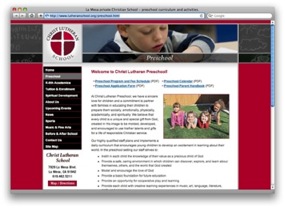
Parental Preferences for Private Faith-Based Pre-School Websites
Team reseach project cowritten with Brian Levels and Laura Cecil.
Link to report (132k PDF file)