My Journey Through SDSU’s EdTec Master’s Program
I have been professionally involved with educational technology since the late 1980’s as a teacher, media producer and private school administrator. Over the years I have worked as an instructional designer, a curriculum developer, a children’s music composer, a sound designer and as a director of technology at a K-8 school in Los Angeles. So after all that, how did I find myself in San Diego, back to school in an EdTec Master’s Program, and struggling to spell the name of a Hungarian psychology professor?
I have a rather eclectic educational history with studies scattered across many disciplines, colleges and attempted degree programs. I earned a B.A. in Philosophy in 1985, and then started graduate studies in child development and musical pedagogy. Later on I switched to a linguistics program but the dot-com bubble in the 1990’s lured me away from school and into multimedia development. At this time I met my wife Joanne and we both worked from home as independent contractors; she as a graphic artist and I as a sound designer and composer. We also studied as much science and art as we could at our local community college, and since then I have been taking advantage of other educational opportunities as they came along: multimedia developer seminars, NASA/JPL educator workshops and C.U.E. (Computer Using Educators) and NECC (National Educational Computing Conference) events.

So the path of my intellectual development has been a meandering one, but one that has led me right to San Diego State University and to educational technology. I truly see this degree as a culmination of my life to this point, integrating the varied interests and skills that I have acquired through my checkered scholastic past.
The Big Ideas
There are many, many ideas and practices that contributed to my growth these past few years, some theoretical and some practical. Often a strange synchronicity would arise between my academic life and my professional life; concepts would be discussed in class just in time to assist with work issues.
If you have already read my biography and other reflections then my choice of these particular three may not come as a complete surprise, but I now present the Three Big Ideas that have engaged me and that I will take forward with me when I graduate:
Eclecticism (variety) - Systems (interrelation) - Environments (totality)
One could say these three ideas are different expressions of a deeper concept of a rich, interconnected educational gestalt. The interaction between the learner and the environment comprise a feedback loop, environments are enriched by diversity, eclecticism draws from multiple systems of thought, and so on.

If variety is the spice of life, then apparently I like life very spicy! As my biography and educational background may have suggested, I enjoy embracing experiences and knowledge from many realms, and am perfectly happy with both complement and contrast in my choices. My attraction to variety is not limited to content: I am quite happy to mix and match practices and theories to meet professional and educational objectives.
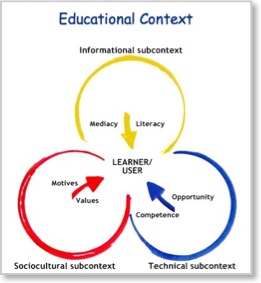
In EDTEC 544, Professor Joseph Williams spoke of the importance of the context of the learner using the SITE model. This was a way to consider the background of an audience, and being an educational theory was also presented in the requisite form of an acronym. SITE refers to the sub-contexts in which a learner is situated: Sociocultural, Informational, Technical and Educational. Additionally, Keller’s ARCS model of Motivational Design describes the stages of engagement with a learner. There are four steps to sustaining motivation in the learning process: Attention, Relevance, Confidence and Satisfaction. Understanding the learner in his or her own situation and then gaining their attention with relevant examples grounds the instruction in their world and builds connections.
I have found that eclecticism has been instrumental in helping build these bridges between the learners and the content. I am able to draw upon references that will connect with varied audiences, cite examples that resonate with the student and engage the learners in their cultural context.
Practically, I am also used to turning to an assortment of tools and techniques in order to produce results. I routinely hop between applications and platforms to accomplish what I need to do: Mac or PC, Analog or Digital, Adobe or Microsoft - whatever tool fits the job will be the one I will use.
For this Big Idea, I present two supporting artifacts that I did not include already in my standards. One was prepared for Dr. Bob Hoffman in EDTEC 671 as part of designing an informal education experience, and the other was a professional presentation I gave at Francis Parker School preparing the faculty for the transition to digital academic records.
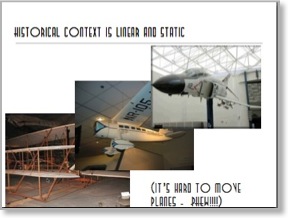
San Diego Air and Space Museum Thematic Tours (372k PDF file)

BlackBaud, The Blues and the End of All Things (2.2MB PDF file)

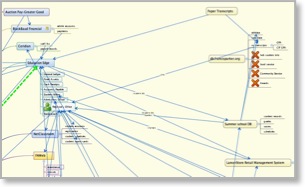
I have always been fascinated with systems. As a child I wanted to find out how stuff worked, relentlessly questioning and experimenting to find out answers for myself. I love discovering how components are interconnected, uncovering feedback loops and processes. My eclecticism paired with my love of systems has contributed to my penchant for analogy and metaphor. I often can recognize the role of a part in a new system intuitively by “mapping” it to a counterpart in another system. For example, while working on the transition from a physical paper report card system to a digital student information system, I noticed the issues and processes paralleled the changes in the music industry the last few decades (see my faculty presentation “BlackBaud, The Blues and the End of All Things” described above).
Nothing happens in isolation. I am constantly looking for the edges and boundaries of interactivity and causality. What are all the factors that contribute to success? What are the inputs and outputs? Where are the feedback loops and connections? My EdTec courses have always advocated looking at systemic solutions, starting in EDTEC 540 with Dr. Robert Mager’s insights on performance problems all the way to Dr. Marcie Bober explaining how to prevent data being influenced during research in ED 690.
But it wasn’t until Dr. Allison Rossett’s EDTEC 685 class that I found and fully adopted this as a professional mantra in the form of “R.S.V.P.” This performance analysis mnemonic stands for:

2. Craft Systemic solutions
3. Add Value
4. Form Personal relationships
Building systemic solutions is itself part of a larger system of values that the performance analyst brings to an initiative. “Focusing on results” recalls crafting learning objectives and outcomes (whether business or educational) and “crafting systemic solutions” emphasizes that nothing happens in isolation in both analysis and response. “Adding value” reminds us to pay attention to why we are even doing this in the first place and “form personal relationships” sets all this in the context of a long term support structure. These values have proven to be a great foundation for me and continue to serve as guiding principles every day in my current work.
What I find so amazing about this mnemonic is how well it distills the essence of improving performance while still acknowledging the different perspectives and processes involved in an enterprise.
The artifact that best embodies this Big Idea is predictably my Performance Analysis (500k PDF file) and PT Makeover (56k PDF file) submitted for the Systems standard.

The R.S.V.P. mnemonic places systems within the context of a long term relationship, focused on results and adding value to an organization. When we look at context at this level, we are really talking about the learner’s environment. This is my third Big Idea and I am interested in both the environment and its relationship to the learner.
Considering the environment in this way includes concepts from the totality of the experience in which the learner is situated to the medium of the content itself. Topics ranging from classroom design or museum installation to user interface design or instructional organizational strategies in my mind are all appropriately linked to this Big Idea.
In EDTEC 685 this theme was manifested in concepts such as scaffolding, “just in time” support and other design elements or performance aids that contributed to success.
During my program, I have also studied the learning environment in a more literal sense. EDTEC 671 discussed informal education, including designing museum displays and installations. In EDTEC 561, my multimedia research project covered virtual realities. Here crafting a learner environment is taken to the extreme - the subject only experiences what the designer has chosen to include. Studies have shown that certain elements are more important than others in contributing to the subject’s experience; by amplifying some aspects (such as narrative storyline) other details (such as polygon count) can be attenuated (McLellan, 2001). Concentrating resources in appropriate areas can reduce the cognitive load of learners, as well as reduce development costs.
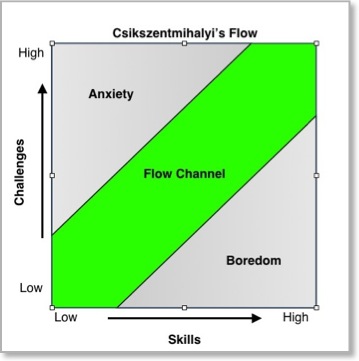
Dr. Bernie Dodge’s EDTEC 670 gave me a chance to explore this further with the design of an actual game experience. In this case, time as well as space became part of the environment as pacing of the experience becomes a key component. Csikszentmihalyi’s (1990) landmark examination of flow described the interactive feedback between the subject and experience as he or she advances in proficiency. This concept finally gave a name to what I had experienced countless times in my life and really resonated with me. It represents much of what I find so fascinating about this field: research on the mind, the psychology of learning and the relationship between subjective experience and the object of attention. It is theoretical, but it prescribes an approach to design that our modern technology can realize in individualized instruction. Educational technology as a discipline not only contains this level of academic research, but also contains within it the capability to practically build on those findings.
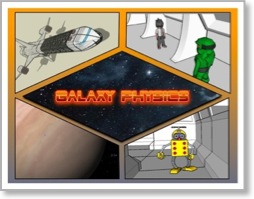
The artifacts that best represent this Big Idea are my projects from EDTEC 670, The Electromagnetic Spectrum Game (offsite link) and Galaxy Physics (offsite link). I am especially proud of how both game environments are matched to the educational content. Developing the Electromagnetic Spectrum Game required adjusting the pacing and being attentive to flow, and movement on game board mirrors the shifting in frequency in the spectrum itself. Galaxy Physics was a proposal for a full exploratory online game, with the actual game worlds embodying the scientific concepts being taught.
Working on these projects reminded me of my childhood experiences with film making and set design. It was a satisfying commingling of creativity, scientific research and educational technology. The artistic construction of a space in which one encounters and explores content combines with the science behind human learning to create a totality of experience for the learner.
The Story Continues...
So it really has been a long journey since I began this program in Spring 2007. I find that I am tired and happy as I approach graduation. For me, SDSU’s Educational Technology Master’s Program has been the perfect blend of theory and practice, technical skills and creative process, and logical analysis and artistic design. My eclectic background has provided a good foundation for this degree, my love of exploring systems of all kinds served me well with performance analysis and improvement, and my imagination and my reason were both engaged when creating rich and functional learning environments.
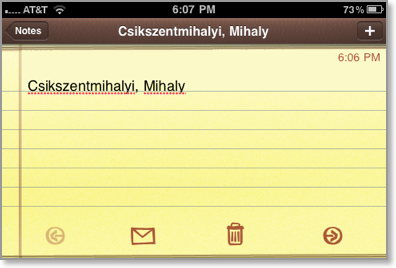
Actually, no I didn’t. But I did learn to pronounce it. And I also learned the difference between remembering a fact and applying a principle, that processes and concepts should be taught differently, about cognitive loads and schemas, about professional standards and performance analysis, about ADDIE and ARCS and SITE and YAA (Yet Another Acronym), and about Captivate and Articulate and Learning Management Systems, and about how humans learn and how other humans can use technology in creative ways to help them do that.
I also have learned that job aids are perfect for this sort of thing: my iPhone has his name as a note in its notepad.
References
Clark, R. C. (2008). Developing technical training (3rd ed.). San Francisco, CA: Pfeiffer.
Csikszentmihalyi, M. (1990). Flow: The psychology of optimal experience. New York: Harper & Row. Chapter 4: The conditions of flow
Keller, J. M., & Suzuki, K. (1988). Use of the ARCS Motivation Model in Courseware Design. In D. H. Jonassen (Ed.), Instructional Designs for Microcomputer Courseware. Hillsdale, NJ: Lawrence Erlbaum.
Mager, R. F., & Pipe, P. (1997). Analyzing performance problems (3rd ed.). Atlanta, GA: CEP.
McLellan, H. (2001). Virtual Realities. In Handbook of Research for Educational Communications and Technology. Bloomington, IN; AECT.
Rossett, A. (2009). First things fast: A handbook for performance analysis (2nd ed.). San Francisco, CA: Pfeiffer.