Core Standard 6: Principles, Theories & Models
Understand many theories and models, choose from among them appropriately, and apply them effectively.
For this standard I chose my instructor-led course design project from EDTEC 650: “Astronomy 101.” Links to the documents are in the sidebar.
Context
Again I find myself drawing upon another artifact prepared for a course taught by Dr. Bob Hoffman. This time I created an instructor led online course as part of EDTEC 650, Distance Education, which I took in Spring 2010. This project focused on designing and developing an online introduction to astronomy course for non science majors. The assignment allowed us to focus either on a single module that would be developed in depth, or to design a course outline and supplementary resources. I chose to design the course outline, and also planned an online mini session using the WIMBA classroom in BlackBoard.
Outcome
My work writing my Encyclopedia of Educational Technology article in EDTEC 561 brought me in touch with multi-tasking research and cognitive load theories. The formation of schemas helps learners organize the information that they are absorbing, and there is research that a narrative context can help prevent cognitive overload. Fisch's (2000) study of children watching educational programming concluded that retention of material was highest when all elements contributed to a cohesive narrative. When different elements are united by a common storyline, they are not subject to the same mental penalty.
Science courses are often notorious for the amount of information with which they bombard the learner. For my course, I wanted to reduce the cognitive load of learners by helping them form a schema. I decided to this by providing a story to frame the concepts of astronomy, as well as communicate how science has changed our understanding of our place in the cosmos. This required chunking the course content into a novel organization. I wanted to merge two narrative directions in the course structure: one from Earth looking out into the heavens (tracing the history of astronomy from the ancients to our modern telescopes and space probes) and the other focused on the universe itself (covering our current understanding of physics and theories of cosmology.) It was a difficult task to weave both these perspectives into a coherent outline, and I am not entirely confident I was successful given the short time to work. I do feel that this approach could be fruitful and I do intend to develop this further on my own.
For models and procedures, I drew heavily on the examples and suggestions from the EDTEC 650 course modules. The text, Conquering the Content, was also extremely helpful in giving very practical methods to manage the work. Both these resources gave me a foundation of techniques that will help with the process of course design and development in the future.
Challenges and Opportunities
This was the first time I led an online instruction session using the WIMBA classroom. I had participated and even led meetings using Adobe Connect and WIMBA, but leading a formal class using this technology was very different. Balancing the timing of the slides with the prepared script and still maintaining a sense of freshness and spontaneity was a difficult task, and it didn’t help that given my schedule I had to broadcast from a busy computer lab.
Additionally, holding down the control key is the default talk button in WIMBA, and unfortunately invokes a popup menu with a mouse click on the Macintosh. I found out that I needed some rather interesting finger gymnastics to allow for broadcasting my voice, advancing the slides and activating the question answer surveys while avoiding control and click at the same time.
I eventually recovered my pacing and became more comfortable with the interface. I found the experience to be very addicting - I would love to be able to offer my course for real some day!
My Contributions
This artifact showcases my ability to cast scientific fact into a narrative format, one that I hope interests the learner. I believe very strongly in eclecticism when it comes to teaching and any good human story that I can bring to the presentation will help connect with someone in my audience. I also think that this project reflects the care with which I approach a presentation, from the look and feel of supporting material to the breadth of resources that I employ when creating a learning environment.
Lessons Learned
I really, really enjoyed this presentation. Throughout my career, I have meandered back and forth between the roles of performance analyst, instructional designer, multimedia developer and teacher. Preparing and presenting online instruction means that I don’t have to choose any more! This project reminded me of how much I love working as an educator, and filled me with enthusiasm and energy. I know that I will only be happy in my future work if it allows me to be an actual instructor at least part of the time.
References
Fisch, Shalom (2000).A capacity model of children's comprehension of educational content on television. Media Psychology. 2, 63-92.
EDTEC 650: Distance Learning

Astronomy 101 - Distance Learning College Course
Link to course syllabus (44k PDF file)
Link to course website (offsite link)
Link to ICARE Module One (offsite link)
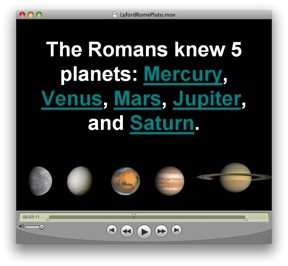
Link to slides from presentation (560k PDF File)
Link to streaming WIMBA presentation (7.4MB MOV file, requires QuickTime plugin)