Core Standard 7: Processes
Understand processes such as change, design, development, and learning.
For this standard I chose both my game design projects from EDTEC 670: “The Electromagnetic Spectrum” and “Galaxy Physics.” Links to artifacts are in the sidebar.
Context
Both these games were prepared for Dr. Bernie Dodge’s EDTEC 670 course “Exploratory Learning Through Simulation and Games” in Fall 2008. “The Electromagnetic Spectrum” is a complete board game that familiarizes players with facts, concepts and principles of the electromagnetic spectrum as detailed in the California Science Framework, grades 6-8. The object of the game is to collect tiles representing each frequency of the electromagnetic spectrum. Players spin the wheel to jump up or down the spectrum, each turn taking an action card or question card from the stack. The first player to collect tiles from all seven frequencies wins.
“Galaxy Physics” is a design for a space based character game (like the "space trading" games of Elite or EVE Online), that also teaches concepts of middle school science. Each star system would cover a different content area, and incorporate the California Science Framework standards in the design of each world. This also allowed content from the entire physics curriculum, and the genre of space simulation seemed a perfect fit to teach concepts of gravity, force, energy, light and electromagnetism.
Outcome
Even though these games have completely different formats, they both were the results of iterative design and development processes. Dr. Dodge’s course provided an excellent foundation in these methods and high quality, creative output of his students speaks to his ability to present fun seriously.
Over the years, I have worked on sound design for a few commercial games as an independent contractor, but never got to see the process in its entirety. I have also dabbled in making a few Flash and HyperStudio games as a hobby. These were just little diversions to please me, and not made with a specific educational or commercial goal in mind. My EDTEC 670 artifacts symbolize the first time I had taken the professional process of game design seriously from the beginning idea to being “ready for market.”
One last point about processes: I appreciated how Dr. Dodge grounded these processes in theory. We learned not only the procedures, but also why they were necessary to achieve our objectives. I was most intrigued by Csikszentmihalyi’s theories of flow and how good design allows the learner to “get in the game.” Theories such as this helped me interpret the results of play testing and incorporate user feedback to improve the games.
Challenges and Opportunities
Designing a game seriously was a completely new experience for me. Great ideas that I had in the original designs were dashed against the hard reality of actually play testing the game. I had several “back to the old drawing board” moments and by the end I had a much better understanding of how all the elements contributed to the player’s experience.
My Contributions
These projects highlight my skill in presenting embedded content in the learning environment. The puzzles in Galaxy Physics embody the facts and concepts that the learner is supposed to master. The 3D game environment is designed with the puzzle in mind: there is no separation of content from the experience.
These artifacts also reflect some of my technical skills, as well an ability to work professionally under tight deadlines and testing cycles.
Lessons Learned
As most of my past experience in this area has been either as a subcontractor or as a dabbler, what I will take with me the most is the seriousness of designing for fun. Hitting the sweet spot to balance the many different elements that contribute to a player’s sense of flow takes creativity, hard work and flexibility to incorporate testing feedback. I have a much better appreciation of just how difficult it is to design an educational experience that feels so carefree and fun.
EDTEC 670 Game Design
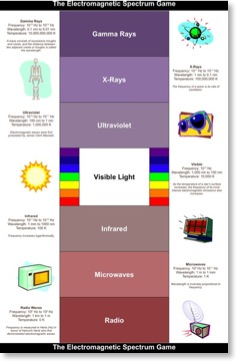
Electromagnetic Spectrum Board Game
Link to Game Board (152k PDF file)
Link to Instructions (64k PDF file)
Link to Game Cards (676k PDF file)
Link to Spectrum Tray (76k PDF file)
Link to Spinner (32k PDF file)
Link to Wiki Entry (offsite link)
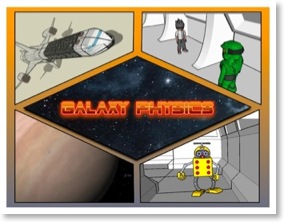
Galaxy Physics Online Adventure Game
Link to Project Report (1.2MB PDF file)
Link to Wiki Entry (offsite link)